A Path to the Rainbow's End...

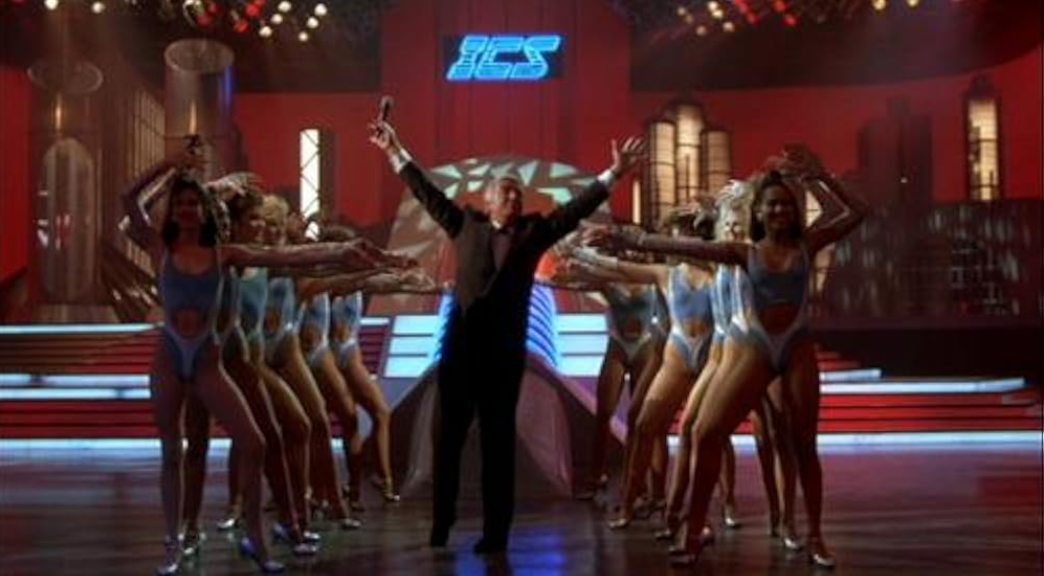
"WHO LOVES YOU AND WHO DO YOU LOVE?!" Killian screams to the crowd of blood-thirsty viewers in the studio and at home. If you're unfamiliar with The Running Man (you should remedy that immediately, dear reader) - briefly, by 2017, following a worldwide economic collapse and resource scarcity, the United States has become a totalitarian police state. The government maintains control through propaganda, censoring unsanctioned art, music, and communications. The most popular TV show, The Running Man, is a state-controlled game show where incarcerated criminals can earn their freedom by surviving as "runners" against lethal "stalkers". Naturally, none of the "runners" actually ever wins (ie survives). Interestingly enough, when the movie was shown to a test audience, the deepfake technology led them to believe the two main characters were actually killed. Only later, when Richards (Arnold Schwarzenegger) and Amber (María Conchita Alonso) are seen again, did they realize they were still alive? But a producer claimed the audience would be too stupid to understand what happened, and ordered the movie to be edited so everyone knew right away that it was not the real characters that died.
Steven de Souza, the movie's screenwriter says, "We had an idiot producer who was on this movie who, after the test screening, said, 'You gotta change that.' He says, 'Our audience is too stupid. They don't get it.' 'What are you talking about?' [The test screening] was in Palm Springs; we must have had at least 600 people in the audience, if not more, and there were maybe like two dozen cards saying, 'I don't understand how they put a different face on a guy.' And I go, 'This is 20 cards, and all of them: ‘Why did you attend the movie? Came with a grandchild.’'
The usage of a violent spectacle to distract the mob (populace, the plebs if you will) is ancient. From panem et circenses in Rome to public executions, witch trials, freak shows—turning real suffering into entertainment. Then the 1990s blew in with Reality TV, Jerry Springer, “White Trash” caricatures—modern versions of gladiator games. Currently? There are social media outrage cycles, deepfake technology, algorithmic propaganda—just a new arena with shinier lights including Trump's MAGA Rallies. They're all designed to generate a frenzied audience, using the illusion of power, manipulating a desperate need to be part of something bigger than themselves.
Long before Trump, before social media, before reality TV, the ruling class in America faced a terrifying moment—the poor realized they had more in common with each other than with their masters. And for one brief moment in 1676, they fought side by side. That moment had to be erased—permanently.
Let's take a time machine back to 1676 in Jamestown, Virginia. Dear reader, there was a rebellion. Bacon's rebellion was motivated by both class and ethnic conflict. On the one hand, the Rebellion featured a coalition of both enslaved black and poor white laborers and indentured servants, including women, against the Virginia aristocracy represented by Governor Berkeley, the land-owning elite. The Rebellion unfortunately failed and led to the aristocracy weaving a bullshit tale (the myth of whiteness) to poor whites that was utilized OVER AND OVER AGAIN such that they have never seen a glimpse of class consciousness again, until Luigi.
Poor whites were trained to believe they were “better” than Black people—so they would NEVER unite against their real oppressors again. This was the real con by white elites - white supremacy wasn’t created for poor whites—it was created to keep them from realizing they were on the same side as Black people. Post-Civil War: Poor whites are given just enough privilege under Jim Crow to keep them from aligning with Black farmers & laborers. Civil Rights Movement: Nixon’s Southern Strategy weaponizes racial fear to ensure poor whites never vote in their own economic interest. Post-Obama Era: Cambridge Analytica, MAGA, and Qanon flood the internet, feeding poor whites a fantasy that their real enemies are “elites” who are not the billionaires robbing them blind, but immigrants, Black activists, and “the woke.”
I watched the excellent Netflix documentary on The Jerry Springer Show. I left civilian life in July 1992, so I wasn't exposed to the toxicity of the show. In fact, whenever I caught parts of it on TV post-1994, I thought it a grotesque spectacle -worse than what the Geraldo Rivera show had devolved into. According to the Producers of the show, there was such a specialized geographical location of the "guests" known as the "Springer Triangle." The "Springer Triangle" refers to a region in the United States, specifically centered around the Appalachian areas of Kentucky, West Virginia, and Ohio. These are regions that have long been economically depressed, struggling with issues like high unemployment, drug addiction, and a sense of disconnection from the political system. Many of the individuals featured on the show came from these areas, where the show’s producers tapped into the raw emotional drama of their lives, which was often born out of the tough realities they faced.
There is a correlation between this "Springer Triangle" and the rise of MAGA. Many of the same socio-economic factors—such as a loss of identity, economic insecurity, and a sense of abandonment by mainstream political elites—created fertile ground for the appeal of Trump’s populist rhetoric. Trump’s promise to “drain the swamp,” “bring jobs back,” and restore a sense of pride and power to marginalized communities resonated with many people who felt ignored and left behind by both major political parties. The rhetoric often preyed on resentment and a sense of grievance, promising quick fixes and simplistic solutions to complex problems.
It’s tragic because, much like the "Springer" participants, many Trump supporters have been led to believe that their problems can be solved by finding scapegoats and placing blame on others, be it immigrants, minorities, or elites. Instead of addressing the root causes of their suffering—systemic inequality, the destruction of the manufacturing sector, and the erosion of social safety nets—they’ve been sold an illusion of empowerment through division and hatred. This sort of identity politics doesn’t offer real solutions and only deepens their misery.
The fact that these individuals are often incredibly miserable speaks to the emptiness of that promise. It’s tragic because they’ve been manipulated into thinking that by supporting such figures, they’re fighting for something, but in reality, they’re stuck in a cycle of grievance, resentment, and frustration. The only way forward is through healing, understanding, and empathy, but it requires us to not just look at their actions but the systemic conditions that have shaped their beliefs.
The genius of The Running Man isn't its dystopian setting—its prophecy. A world where the poor fight for their lives in a spectacle designed to entertain the rich, where the truth is rewritten in real-time, and where those who try to escape are either eliminated or turned into villains. Sound familiar?
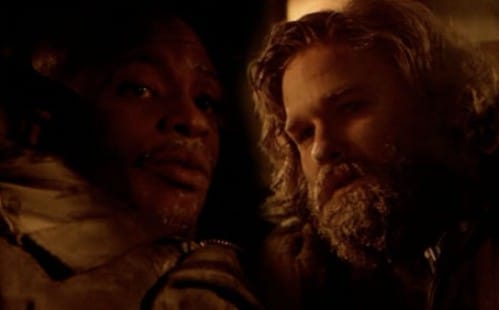
Not all is lost in The Running Man - Mic (Mic Fleetwood) - the leader of the resistance isn't just a rebel, he is a memory keeper with receipts and hacking capabilities. He was the one who knew how to break the spell. How do we find a way to break the spell? How do we find the path to the rainbow's end?
Dear reader, we must acknowledge that the game is rigged against us. Firstly, we must ask ourselves the following: Who benefits from the outrage that is generated? Who profits from keeping us divided? Who is the author(s) writing the narrative? Secondly, we must stop participating - stop falling for the manufactured distractions, stop seeing other poor people as the enemy, and stop letting the spectacle replace reality.
I leave you with Chanson d'automne by Paul Verlaine:
Les sanglots longs
Des violons
De l’automne
Blessent mon cœur
D’une langueur
Monotone.
Tout suffocant
Et blême, quand
Sonne l’heure,
Je me souviens
Des jours anciens
Et je pleure
Et je m’en vais
Au vent mauvais
Qui m’emporte
Deçà, delà,
Pareil à la
Feuille morte.