Angel of the City...

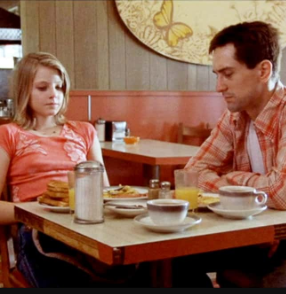
Robert Tepper's Angel of the City, emerging 10 years after Martin Scorsese's neo-noir classic, Taxi Driver, echoes in the wind with the same breeze as the messages of the film. Early in the movie, we see Betsy (portrayed by Cybil Shepherd) dressed in white and referred to by Travis (portrayed by Robert de Niro) as an Angel. Betsy, a campaign worker for a politician named Palantine (interesting that wordplay as the term palatinus was first used in Ancient Rome for chamberlains of the Emperor due to their association with the Palatine Hill). Betsy tells her co-worker that they are indeed "selling mouthwash." Betsy calls out the political illusion of freshness, purity, and cleanliness, but in reality, it’s just a mask for rot. Further, she tells him to "put on his glasses" as he claims not to see Travis sitting out in his taxi stalking Betsy - she sees him though. Betsy’s co-worker, watching Travis loiter outside the campaign office in his cab, couldn’t recognize him for what he was. It wasn’t that Travis was invisible, but that those around her refused to acknowledge him as a threat.
What do we refuse to see when the truth makes us uncomfortable? And what of Betsy? She's no Angel, she held the keys to Travis' unraveling. Later, we see many bouquets - flowers he purchases for Betsy yet never sends to her. He proclaims they "give him a headache," so why buy them in the first place? He would burn those dried flowers he had bought for her—a funeral pyre for his illusions.
We are introduced to our real Angel of the City, Iris, the child prostitute, as she hops into Travis' cab asking for him to drive off. She was like a ghost, slipping through the city’s neon arteries, high and half-seeing. She's dragged out of the cab, and the crumpled-up $20 he's given "to forget" the incident he pockets - it was his ticket to seeing and potentially "saving" Iris.
Travis determines that he must "get into shape" and begins to undergo a metamorphosis, purchases weapons, and decides it's time to meet Iris. Matthew (AKA Sport to Iris) stands in a doorway as Travis sees Iris and her companion on the street. She remarks whom Travis may speak to about a trist with Iris and he approaches Matthew. Matthew believes Travis is a cop - and why not? In Travis' delusion, he believes he is a Secret Service Agent - at least that's what he alluded to in the Anniversary Card he wrote to his parents. It was natural for Matthew to be suspicious. Travis pays and Iris takes him to her room. It's romantically decorated - an oasis really compared to the rest of the building - the city itself. He asks her her name and she responds "Easy." That wasn't her real name of course and she confesses her real name is Iris. Interesting about the meaning of her name as well - Iris, of Greek origin and meaning "rainbow", a colorful flower and the pigmented part of the eye. Travis refuses Iris' sexual advances, even though that's what he did pay for. He begins to question her about that night when she jumped into his cab - at first she denies remembering it - then admits she remembers and that she was high. Iris insists that Travis look into his own eyes in the mirror during the conversation and he asks if he can see her again. She agrees to breakfast the next morning.
While at breakfast, Iris proclaims that those around her protect her even from herself—but who were they really protecting? The truth is that "protection" was just another form of control. Her body, her youth, her very breath was a commodity, used and repackaged by the ones who said they loved her. She jokes that she got along with Sport because they were both Libras. She mentions the fact that her family are air signs and that is their problem, yet does not associate herself with them despite Libra being an air sign. She asks Travis if he is a Scorpion, not a Scorpio. Not a zodiac sign but a dangerous predator illuded to earlier when Travis' cabbie friend tries to give him Errol Flynn memorabilia to sell and share in the profits. Errol Flynn—the swashbuckler, the romantic, the legend. And beneath the glamour? The predator, an accused abuser of underage girls, the Hollywood myth that coated truth in gold and sold it to the masses. Travis was no different.
I suspect Iris had met many Scorpions before - I know I have and I am sure, you dear reader, have as well.
At the end of the movie, we see Travis entering Iris' building as her liberator, her savior, her Messiah - at least in his mind. He kills Matthew, the gatekeeper, and an armed client whilst getting shot several times himself. When Travis pulled the trigger, when blood pooled and splattered, when the newspapers wrote his name into history, something strange happened. The pictures in the articles posted on Travis' wall didn’t even look like him. He had been transfigured, rewritten, and cleansed by ink and myth. The city had taken his violence and turned it into a salvation story. He wasn’t arrested, wasn’t questioned—he had removed the kind of men the system allowed to be erased. The same system that had always known about the Sport-types, the traffickers, the ones who whispered to lost girls and promised them a world outside their suffering. The system let them thrive until it needed a new hero. Even if that hero was a maniac. What is a hero anyway? The city decides. The papers decide. The ones who need myths more than they need truth.
But unlike Iris, I wasn't given a savior. I ran away from home at sixteen, escaping an abusive narcissistic mother who would rage, violently beat, and emotionally abuse. She would write pages of venom and my childhood home was where love was a blade, so I ran. I'd tried to run away at 8, but my mother saw me walking away in our driveway in the night and thus was ensnared again - powerless until I could legally go at 16. I moved in with a man who was supposed to be an escape and instead became a prison. Five years my senior, violent, unstable, an addict. The ones who gave us shelter were adamant about one thing - that we weren’t "living in sin." So we married.
At seventeen, I found my way out by enlisting. The Army was its own kind of cage, but it was a choice. It was a way to disappear without having to run anymore - and it provided security. I filed for divorce and never looked back.
And I see it now. I was my own rescuer. I was my own savior.
At the end of Taxi Driver, we hear the narrative voice of Iris' father proclaiming that they would ensure they didn't do anything that would merit Iris running away again - how very few runaways get such a promise.
Travis' final interaction with Betsy shows him to be the consummate coward as he quickly shift his rearview mirror after catching a glimpse of himself post dropping Betsy off. Betsy wasn't the Angel of the City, Iris was. As Tepper sang, "Some survive her, most go under." Iris was truth in Travis' world - perhaps that's why it was imperative for him to save her - to save what shred of truth within him might still be saved. But he welched.
Iris was a girl, young, breakable, and too knowing for her age through the journey she'd taken at just before thirteen years old. Instead of welching, I took her challenge, and saw similarities in my own story - a story I've not really spoken of until now. But it ends well even if it is a mystery still unfolding.
But I challenge you - will you look into the mirror?
I leave you with The Painter's Vision:
Eyes, artists painting without a brush,
Capturing moments in a silent hush.
Each glance, a masterpiece, unique,
A gallery of emotions, mystique.