Say Hello to the Night...

A fellow practitioner asked me how was it I used mirrors in my practice - my response was simply working with water spirits, accompanied by the appropriate cautionary messaging. Water approaches the reflectivity of a perfect mirror only when you look straight across it at a shallow angle - known as the angle of incidence. The waters must be placid; calm weather is essential. In order to appropriately view the reflection staring back at us, the outward conditions must mirror the inward - calm. What happens when there is no light? During the day, sunlight illuminates the water, making it transparent so you can see through it. At night, with no sunlight to illuminate the depths, water absorbs light instead of transmitting it. The surface darkens - becoming a highly reflective black mirror. What was transparent becomes reflective. The brightly lit objects above stare back at us from below.
Tezcatlipoca, an Aztec deity of the night sky, sorcery, destiny, and war, used an obsidian mirror to see all sins, actions, and fates on earth. Oshun, the Orisha of the sweet waters, saw her reflection in the river, which taught her how to look inward, heal from her struggles, and strive for self-improvement. The mirror does not merely reflect appearance, but the hidden self beneath performance, illusion, and longing.
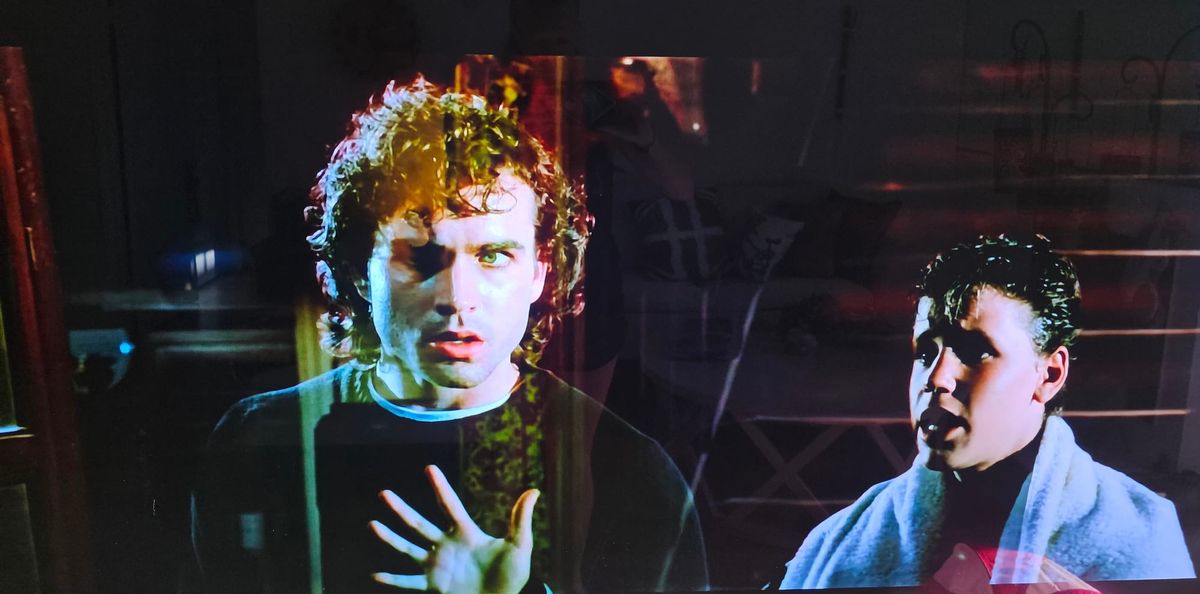
When the reflection begins to become translucent, and the solidified, sovereign self begins to fade - as Michael's did in Lost Boys - how can one recover what was lost, and more importantly, what will your reflection be afterward?
The journey Michael takes from seduction, glamour, and longing to self-remembrance and strength ultimately relies on the realization that he never truly lost his essence and the loving support of his younger brother, Sam. It's through Sam's child-like curiosity and wit that Michael sees himself fading. His fading reflection is not merely the result of drinking vampire blood. It marks the moment seduction, betrayal, and longing begin to sever him from the self he once knew.
Star (Jamie Gertz) becomes the entry point through which Michael falls prey to forces far larger than himself. In fact, I would argue that the only reason why Star is a part of the Lost Boys led by David (Keifer Sutherland) is solely as bait, along with the young child, Laddie (Chance Michael Corbitt). Once isolated within the underground cavern of the Lost Boys, reality becomes a distortion through glamour- noodles are worms, grains of rice are maggots, blood is wine. Even with a warning, Michael drinks, surrendering his sovereignty to the dreamlike world that has woven about him.
Michael's initiation takes him to the railroad tracks, where he is told he is now one of the Lost Boys - Michael has no idea that he is no longer in his own agency. One by one, they jump below the train tracks that traverse a bridge to hang below. Michael is urged to trust his new place among the tribe by letting go - a surrender ritual in which the old self must die before rebirth. Once Michael can no longer hang on to the bridge, he lets go and falls into the mist below.
In the Celtic tradition, mist is a threshold that must be crossed to enter the Otherworld. Manannán mac Lir is a prominent sea god and ruler of the Otherworld in Gaelic mythology, famous for his deep connection to fog and weather. He is best known for using a magical mist of invisibility, the féth fíada, to conceal islands and protect the surviving Tuatha Dé Danann gods from mortal eyes. When the marine layer rolls in off the Pacific, I often invoke Manannán mac Lir - what truths may I safely witness beneath his mist of invisibility, I ask in the invocation.
When we find ourselves in coercive systems, whether they be abusive relationships, cult dynamics, online radicalization, toxic masculinity, addiction, performative identities, or even modern social media culture, the exit is treacherous - as the conclusion of the Lost Boys illustrates.
Michael, Star, and Laddie realize they are ensnared within a predatory system from which they have withdrawn their consent to participate - they begin to assert their sovereignty for their liberation. Instead of becoming hunters, they become the hunted, and only their annihilation will suffice. It is then the "maker" of all of them is truly revealed, as well as his true intentions - it was never about a "family" per se, it was about his own longing for Michael and Sam's mother, Lucy. It should not be lost on anyone that Lucy Westenra was Count Dracula's first victim in Bram Stoker's depiction - in the Lost Boys, Lucy is what appears to be marked as the first mate to Max, the head vampire. It was her generous nature, her light, that drew him to her in the first place.
In the film, Lucy admits to her father that she walked away from her divorce in a despondent financial state, choosing peace instead of a long, drawn-out court battle. Her inability to firmly claim what may have been rightfully hers in the divorce, along with Max's accusation that her sons "run all over her," seems to indicate he knows her weakness - her children. Max even admits at the end of the film that he knew if he could turn Sam and Michael, there was no way she would deny him. The very beings that she fought to protect, Max now sought to destroy, for a twisted partnership dynamic meant only to extract.
At the end, the final true villain is revealed - Grandpa, Lucy's father. Sure, he shows up in the nick of time to save the day, but where was he before? "One thing about living in Santa Carla I never could stomach: all the damn vampires." Perhaps he didn't know precisely who the vampires were, given his avoidance during the dinner scene, I would venture a guess that he at least suspected Max, and yet said nothing. If he had told his daughter and grandsons about his suspicions, would they have even listened? After all, they did a gold Olympic-level eyeroll at his comment, "if all the dead stood up at once, they would have one hell of a population problem."
Escaping coercive dynamics takes courage, resilience, and strength - witnesses who can assist in preventing such entrapments with truth should speak. The mirrors of calm discernment will always reflect the light shining within.
I leave you with Mirror by Silvia Plath
I am silver and exact. I have no preconceptions.
Whatever I see I swallow immediately
Just as it is, unmisted by love or dislike.
I am not cruel, only truthful‚
The eye of a little god, four-cornered.
Most of the time I meditate on the opposite wall.
It is pink, with speckles. I have looked at it so long
I think it is part of my heart. But it flickers.
Faces and darkness separate us over and over.
Now I am a lake. A woman bends over me,
Searching my reaches for what she really is.
Then she turns to those liars, the candles or the moon.
I see her back, and reflect it faithfully.
She rewards me with tears and an agitation of hands.
I am important to her. She comes and goes.
Each morning it is her face that replaces the darkness.
In me she has drowned a young girl, and in me an old woman
Rises toward her day after day, like a terrible fish.