The Gambler - Part 2 - The Prisoner's Dilemma

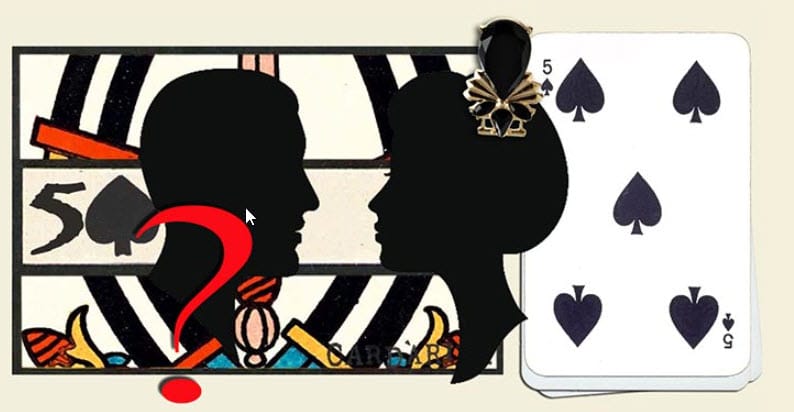
As we saw in Part 1 of this series, incarnation is so much more than what we superficially perceive - let's dive into the cards - the games we play, and how we can win, lose, or draw - but I'd challenge you to think that all three are happening simultaneously, especially since I'm about to get on a plane to Las Vegas no less.
When the 7 Hathors spread hit my inbox (you can find it here on the Pen & Priestess page) - I immediately sped to a deck that screamed "use me for this!" Kim Krans' Wild Unknown Tarot came running through like a herd of elk - and thus the cards were drawn. The 3rd card in the spread, my joy, where I find happiness and wholeness, is not one that anyone would want to see - for me it was the 5 of swords, and thus this piece.
The entire suit of swords (or spades in traditional playing card decks) is an extremely complicated suit - thoughts, communication, and how we breathe (and birth) those thought forms into the world - shadow and flame, light and dark, feather and density dance together in this suit like two long lost Tango dancing lovers who've met their match on the dancefloor. To master this suit is to become a Maître d'armes of all forms of communication - and I sit in awe of those in the unseen realms who have stepped forward as instructors for me - namely, my god-parents, Odin and Frigg. Words and thoughts are weapons, they can also generate prisons and chains, both seen and unseen.
I had an extremely vivid nightmare the other night, truly something that Stephen King would've written for Creep Show. I asked my mediumship circle about it - I was not to birth the story I witnessed into the world - and that made me wonder about some of the horror genre that surrounds us. The dreams of others and how we may be prisoners to the thought forms of others that they chose not to view with discernment, but to dump that traumatic dream upon reality, which you guessed it, can generate a shitload of money - people like to be scared.
So instead of writing what I dreamt in frightening detail, I began my journey of curiosity - what did it have to teach me? Ultimately, what came was quantum entanglement and game theory - thus the title of this piece, The Prisoner's Dilemma. What is that you ask? It's a classical game theory scenario illustrating how self-interest can lead to a suboptimal outcome for all involved, even when cooperation would be mutually beneficial. While individual gain is tempting, pursuing it can lead to a worse overall result than if everyone cooperated. I asked myself, what if the two players walked away with their swords and abandoned the other three?
When I first met my soon-to-be ex-husband, the first night we met, we read the tarot. The outcome of the relationship was clear - the 5 of swords. When I first saw that, I walked away - cards on the table done. What I didn't know and didn't understand was that there was so much more at play that I knew or understood at the time - that was 9 years ago. Which takes me back to that Joy card of the 7 Hathors spread - how can the 5 of swords be my joy? If the other player isn't meeting me where I am, and we aren't mutually benefiting each other, then I walk away - I refuse to play, and thus refuse any notion of being a prisoner - clarity is the outcome ultimately.
The story of this card is so reminiscent of the Count of Monte Cristo - Dantès, a French nineteen-year-old first mate of the merchant ship Pharaon, is falsely accused of treason, arrested, and imprisoned without trial in the Château d'If, a grim island fortress off Marseille. A fellow prisoner, Abbé Faria, correctly deduces that romantic rival Fernand Mondego, envious crewmate Danglars, and double-dealing magistrate De Villefort are responsible for his imprisonment. Throughout their long imprisonment, Faria educates Dantès and, knowing himself close to death, inspires him to retrieve for himself a cache of treasure Faria had discovered. After Faria dies, Dantès escapes and finds the treasure. As the fabulously wealthy, powerful, and mysterious Count of Monte Cristo, he enters the fashionable Parisian world of the 1830s to avenge himself.
One would think that the Prisoner's Dilemma here is with Faria and Dantès - no, it's initially between Dantès and his false accuser and his insatiable need for revenge. What if the Prisoner's Dilemma in the game of incarnation is precisely that? We've been wrongfully accused in the past (or past life), imprisoned, and punished - how will we escape, and when we do, what will we do with our newfound freedom? Will we choose the path of vengeance (destruction) or beauty by instructing and assisting others with their own Prisoner's Dilemma?
In the Hoodoo tradition, the 5 of spades can symbolize illness - but that card can also be used to kill a jinx. What is a jinx? A spell that's been cast on a person to have bad luck, or their luck has run out. This is not a hex - hexes are meant to cause serious harm or misfortune for a longer duration and with greater severity. That brings some sigh of relief, doesn't it? The minor arcana in the tarot - they're mundane, daily experiences that give us insight - although the spades can be indicative of years.
So now that we've discovered the secret to escaping the Bardo is through cooperation (with ourselves by the way) - what will we do with the freedom we've found?
I leave you with The Jinx by Haydn Swan
You say it's just a Jinx ?
the alchemist's last kiss
I'l tell you of a life in vain
struggling in this darkness
life lived in a Pandora's box
opened the lid in this misty haze,
just a jinx I hear you say
but I tried to follow the eternal code
rain down my face
not knowing my place
but in the last of these days
I found the code of my DNA
no more time to smile
pushed to walk the extra mile
now this jinx is my warmest coat
settled in to this dark Catacomb.